
GoldWin Complaints: Withdrawal, Verification and Support Issues
 Available in GB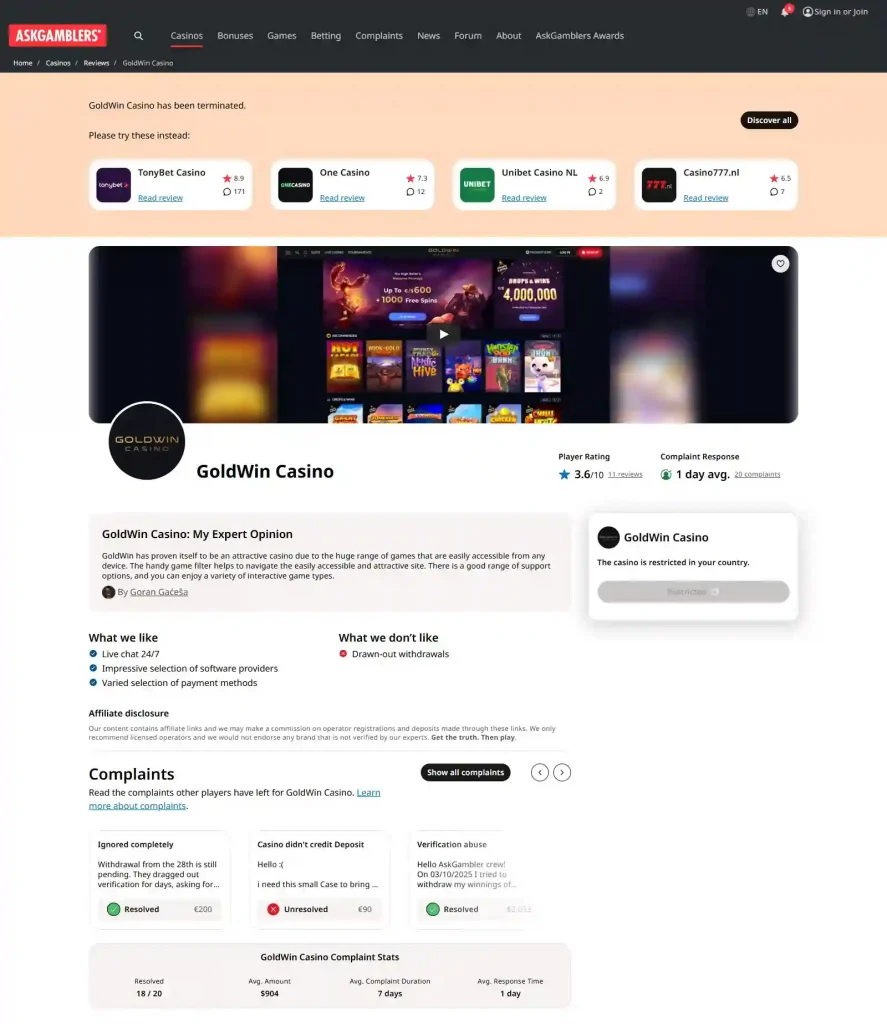
Current complaint platforms contain GoldWin cases involving delayed withdrawals, repeated verification requests, missing deposits and dissatisfaction with support. They also contain cases that were later marked resolved, rejected or otherwise closed. That mixture matters. A complaint is evidence that a particular player reported a problem, not proof that every account will encounter the same problem or that every allegation was established.
For UK readers, the useful approach is to separate three layers: what the player alleges, what the operator’s written policy actually says, and what the complaint platform records about the outcome. GoldWin’s current terms confirm identity and anti-money-laundering checks, publish withdrawal limits for specific non-GBP currencies, and provide an internal complaint process. They do not support turning individual reports into a fixed payout-delay claim. This page therefore focuses on evidence quality, practical record keeping and escalation rather than a reputation score.
Table of Contents
What current complaint sources show
AskGamblers lists 20 GoldWin complaints and marks 18 as resolved. Its visible case list includes reports concerning withdrawal delays, verification requests, deposit-crediting problems and support responses. Some examples involve players saying that withdrawals remained pending after verification, while another case describes repeated requests for documents before a withdrawal. Those descriptions are allegations made within individual cases, not findings that GoldWin applies the same process to everyone.
Casino Guru presents a broader database. Its current GoldWin page shows 76 complaints in total, with a mixture of resolved, rejected, opened and unresolved statuses. The visible titles likewise include delayed withdrawals, locked or cancelled withdrawals, lost or pending deposits and winnings not yet received. The platform also explains that its complaint metrics are assessed in relation to casino size and may include related casinos, which is another reason not to reduce the database to a simple count of negative experiences.
The evidence does not support treating delayed withdrawals or successful resolutions as universal GoldWin outcomes. The defensible observation is narrower: withdrawal, verification, deposit and support issues recur across current complaint listings, while outcomes vary. A reader should inspect the date, disputed amount, operator response, evidence supplied and final status of each case before deciding how much weight to give it.
Review comments require even more caution. They may describe genuine experiences, but they usually contain less structured evidence than a complaint file and can include frustration, assumptions about motive or details that cannot be independently checked. Use them to identify questions worth investigating, not as a substitute for the current terms or a documented case outcome.
How to separate allegation from verified policy
The most useful cross-check is the operator’s current written policy. GoldWin’s terms state that withdrawals can be requested once incoming payments have cleared and the required checks have been completed. The same terms confirm that identity and anti-money-laundering verification can be required and may include valid photo ID, recent proof of address and additional information about source of funds. That means a complaint saying that verification occurred before a withdrawal is plausible as a description of the process, but the complaint alone does not establish that a particular document request was improper.
The terms give currency-scoped withdrawal boundaries for several non-GBP currencies, but those figures should not be converted into sterling. They do not establish one fixed GBP processing time either. The practical check is the live cashier or help area for the values shown to the account, while KYC can also affect the withdrawal process. Complaint anecdotes should not be turned into a guaranteed or standard delay for every player.
That distinction is important when reading a case. A disputed withdrawal amount should be compared with the rule that actually applied to the account currency at the time, while a reported delay should be compared separately with any processing information shown for that request. A complaint can therefore contain one policy-relevant detail without proving a general rule about timing or limits. Compare each issue separately and use the applicable terms or account-level cashier information where available.
Policy evidence also has limits. Written terms describe what the operator says should happen; they do not prove that every individual case was handled correctly. Conversely, a complaint describes one reported experience; it does not rewrite the policy for every user. Strong analysis keeps both forms of evidence visible rather than allowing either one to stand in for the other.
Resolved versus unresolved cases
A resolved complaint usually deserves more attention than a raw negative review because it contains some indication that the case reached an outcome. Even then, “resolved” can mean different things. The player may have received funds, supplied documents, accepted an explanation, or simply reached a point where the platform closed the case as satisfactorily addressed. The status is useful, but the case text is needed to understand what changed.
An unresolved complaint is also not an automatic judgment that every allegation is true. It means the dispute was not recorded as successfully resolved through that platform’s process. Reasons can include continued disagreement, lack of response, insufficient evidence or a result the complainant did not accept. A rejected complaint may reflect the platform’s assessment that the claim lacked merit, fell outside its rules or was not supported well enough. The platform’s own explanation should be read before assigning meaning to the label.
Dates matter too. A complaint from several years ago may relate to an older operator, older terms or payment procedures that have since changed. A recent complaint is more useful for current operational context, but it still needs the same evidence checks. The safest reading method is to prioritise recent, documented cases and then compare them against current policy rather than treating all historical complaints as equally representative.
For that reason, complaint counts work best as a discovery tool. They can reveal recurring categories that deserve scrutiny. They are much weaker as a direct prediction of what will happen to a new player, because they do not show the total number of transactions or players that occurred without a complaint.
Withdrawal evidence worth keeping
If a withdrawal becomes disputed, a clean evidence trail is more useful than repeated paraphrases of what happened. Save the withdrawal request screen showing the amount, currency and timestamp. Keep the transaction or request identifier if the cashier provides one. Save a record of the withdrawal status before it changes and keep any later cancellation or reversal notice.
For verification, record the date each document was requested and the date it was submitted. Keep the operator’s confirmation or rejection message, but avoid storing sensitive identity files in insecure locations or sending them to review sites. A complaint platform generally needs enough evidence to understand the sequence, not unrestricted copies of every personal document. Redact passport numbers, bank account details, home addresses and other information that is not necessary to explain the dispute.
Support records are equally important. Save chat transcripts or records that show the question, the answer and the date. If one agent gives a different explanation from another, keep both rather than summarising the contradiction from memory. For email, retain the full thread and message headers where practical. A timeline built from contemporaneous records is easier for an operator or complaint mediator to follow than a long narrative assembled later.
Also save the relevant terms version or a dated copy of the clause you relied on. GoldWin’s current terms carry an update date, and policies can change. If the dispute concerns a minimum withdrawal, verification request or complaint response, the terms in force around the transaction can be more probative than a version captured months afterwards.
Finally, separate facts from conclusions in your own notes. “Withdrawal requested at 14:10 on 3 September; status still pending on 8 September” is stronger evidence than “they are deliberately delaying me”. The first statement can be checked. The second is an interpretation of motive and is much harder to establish.
Support and escalation limits for UK readers
GoldWin offers 24/7 live chat support, but a chat conversation should not be treated as the final record for a material dispute. The current GoldWin terms set out a complaint procedure: a player can send a complaint with as much detail as possible, the support team may escalate an unresolved complaint to management, and the terms say a response will be provided within 10 working days. They also provide a further internal escalation address when the player believes the complaint was not adequately resolved or no response was received.
For a practical escalation sequence, start with one clear written summary containing the account identifier, transaction date, amount, status and the remedy requested. Attach only the evidence needed to support those points. If the answer does not resolve the issue, reply on the same thread so the history remains intact and use the internal escalation path specified in the current terms.
UK readers should not assume that a UK Gambling Commission alternative dispute resolution route applies to GoldWin. The GoldWin licence page explains the operator’s regulatory position. A UKGC-linked ADR process belongs to the Great Britain licensed framework and should only be presented as available where the operator’s status and dispute arrangements support it.
If the problem is specifically a withdrawal, use the withdrawal checks page to compare the live request against the account-level withdrawal limits and KYC conditions. For identity-document questions, the verification checks page explains the verified document categories and why additional checks can arise. The main GoldWin UK review keeps those issues in the wider product and regulatory context.
How to read GoldWin complaints without overgeneralising them
A useful complaint is one you can interrogate. Check when it happened, what amount and currency were involved, whether the account was verified, what the operator actually said, whether saved records or transaction references support the timeline, and how the case ended; give more weight to a documented recent case than to an undated review that offers only a conclusion.
Then compare the disputed point with current policy; a complaint can reveal a real friction point even when the operator acted within its published rules; equally, a written rule does not prove it was followed correctly in a particular account; the strongest interpretation keeps allegation, policy and outcome separate until the evidence connects them.
For GoldWin specifically, current complaint databases show recurring withdrawal, verification, deposit and support themes, while their recorded outcomes are mixed. That is enough to justify closer checks before depositing or withdrawing, but not enough to predict one universal result. Keep your own evidence, use the written complaint route, and judge individual cases by the quality of their records rather than by the strongest language used in a review.
When comparing complaint cases, consistency is more useful than volume alone. Several reports that describe the same type of friction can justify checking that issue more carefully, but they still do not establish that every account will have the same outcome. Give the most weight to cases with dates, transaction context, operator responses and a recorded resolution, because those details let you compare the complaint with the written policy instead of relying on the reviewer’s conclusion alone.
That keeps the comparison disciplined.
Recommend

GoldWin Licence and Trust UK: Anjouan, UKGC and Player Protections
GoldWin's current official terms identify Upscale Entertainment Ltd as the operator and state that the...

GoldWin Registration UK: Account Setup, Login and First Checks
GoldWin registration starts with a personal account created on the official goldwin.com site. The current...

GoldWin Bonus UK: Welcome Offer, Terms and What to Check
GoldWin UK Guide GoldWin currently presents a welcome package for new players, but the headline...

GoldWin Games: Slots, Providers and Casino Library
GoldWin UK Guide Recent independent 2026 listings place GoldWin's library above 3,000 games, with slots...

GoldWin Payment Methods UK: Deposits, GBP and Cashier Checks
GoldWin lists a broad set of payment categories, and independent current sources support Visa, Mastercard,...

GoldWin Mobile Casino UK: Browser Play and App Status
GoldWin works through a mobile browser, and the current first-party homepage also advertises a downloadable...