GoldWin Licence and Trust UK: Anjouan, UKGC and Player Protections
 Available in GB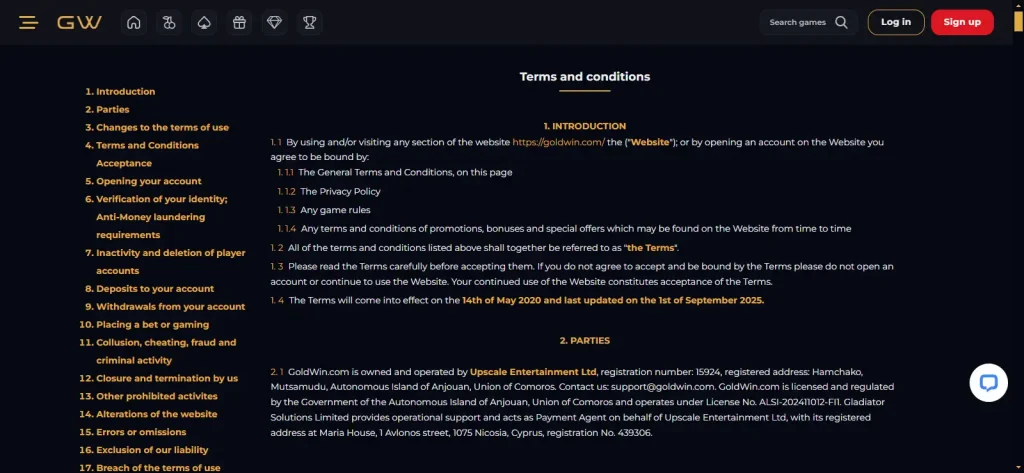
GoldWin’s current official terms identify Upscale Entertainment Ltd as the operator and state that the casino operates under Anjouan licence ALSI-202411012-FI1. The Gambling Commission public register does not identify a UKGC licence for GoldWin or the named operator. Those are two separate regulatory facts: GoldWin has an identified offshore licence, but UKGC status should not be attached to the brand on that basis. For the wider product context, see the GoldWin UK review.
For a reader in the United Kingdom, the distinction matters because Great Britain has a specific remote-gambling licensing framework. Operators providing remote gambling facilities to consumers in Great Britain generally need a Gambling Commission licence. Northern Ireland sits outside the Gambling Act 2005’s ordinary Great Britain jurisdiction, so broad phrases such as “UK licensed” can hide an important territorial difference. The practical task is to understand which regulator and protections actually apply rather than treating a licence badge as a universal trust signal.
Table of Contents
- GoldWin's verified licence
- What the UKGC register check shows
- Great Britain and Northern Ireland are not the same regulatory scope
- GAMSTOP and UK-local protections
- How to assess trust beyond a licence badge
- Why licence status does not rewrite unrelated product facts
- What the GoldWin licence position means in practical UK terms
GoldWin’s verified licence
The current GoldWin terms name Upscale Entertainment Ltd as owner and operator and give company registration number 15924. The same terms identify an Anjouan gaming licence with number ALSI-202411012-FI1. Because the licence number is a high-risk fact, it should not be copied from an old affiliate review or a search snippet when the operator’s current terms can be checked directly.
An Anjouan licence is not the same regulatory instrument as a Gambling Commission licence. The jurisdictions have different legal frameworks, licence conditions, enforcement mechanisms and consumer-protection systems. A player should therefore avoid translating the existence of one licence into assumptions about another regulator’s rules. The useful statement is narrow: GoldWin’s current terms identify an Anjouan licence, and no UKGC licence is identified in the Gambling Commission public register.
The operator name matters as much as the brand name. Gambling sites can use a trading name that differs from the legal company holding the licence. When checking a regulator or reading terms, compare the casino name, legal entity, licence number and current domain together. A badge without those connections is weaker evidence because it does not show which company is responsible for the service.
Licence information can also change. Operators can migrate entities, licences can be amended or replaced, and terms can be updated. Licence information can change, so compare the current GoldWin terms with the regulator record before relying on the position described here.
What the UKGC register check shows
The Gambling Commission maintains a public register of licensed gambling businesses. For this page, the relevant question is whether GoldWin or its identified operator appears there with a licence that supports remote casino activity. The Gambling Commission public register does not identify such a licence for GoldWin or Upscale Entertainment Ltd. That is why this page does not describe GoldWin as UKGC licensed.
The absence of a verified UKGC entry should be interpreted precisely. It does not by itself answer every question about whether a particular person can access the website, whether a specific payment method works, or whether the casino has games that load from the UK. Regulatory status and technical or operational access are different dimensions. A successful registration screen is not proof of local licensing, and a licence check should not be used to invent conclusions about unrelated features.
For Great Britain, the Gambling Commission states that a remote casino operating licence is required when an operator provides remote gambling facilities to consumers in Great Britain, regardless of where the operator is based. The Commission’s remote-casino licence covers online casino games such as slots, roulette, blackjack and poker. That makes the register a meaningful reference point when a site is presented to consumers in England, Scotland or Wales.
This page avoids turning that rule into a blanket legal verdict about GoldWin. The relevant factual comparison is narrower: the operator’s own terms identify an Anjouan licence, while a UKGC licence was not verified in the public-register evidence. Readers who need UKGC-regulated protections should understand that those protections arise from the UKGC licensing framework itself and should not be assumed to follow an offshore licence.
Great Britain and Northern Ireland are not the same regulatory scope
In gambling regulation, “UK” is often used too loosely. The Gambling Commission explains that the Gambling Act 2005 covers Great Britain – England, Scotland and Wales – but not Northern Ireland for general gambling regulation. Northern Ireland has its own legal arrangements, although some UK-wide matters, such as the National Lottery, are handled differently.
This territorial distinction matters when reading claims about licensing requirements or consumer rules. A statement about what a remote operator must do to serve consumers in Great Britain should not automatically be rewritten as a statement about all four UK nations. Likewise, the phrase “UKGC licence” is shorthand for a Gambling Commission licence, not a licence issued by a single regulator with identical ordinary gambling jurisdiction throughout the whole United Kingdom.
For a reader in England, Scotland or Wales, Great Britain rules are the relevant local benchmark. For a reader in Northern Ireland, the legal context is different and should be checked against the rules that apply there. This site therefore uses “Great Britain” when discussing the Gambling Commission’s ordinary remote-gambling licensing jurisdiction and uses “UK” only when the source or subject genuinely covers the wider United Kingdom.
That distinction is not merely semantic. It helps prevent regulatory claims from being made broader than their source supports, especially on topics such as licensing, self-exclusion obligations and statutory controls.
GAMSTOP and UK-local protections
GAMSTOP is the national online self-exclusion scheme used by gambling companies licensed in Great Britain. GAMSTOP states that all online gambling companies licensed in Great Britain must participate, and registered users are blocked from gambling websites and apps covered by those participating operators. The scheme is therefore tied to the Great Britain licensing framework rather than to every gambling website accessible from the UK.
Because no UKGC licence was verified for GoldWin in the current register check, this page does not claim that GoldWin participates in GAMSTOP or that a GAMSTOP registration will block GoldWin. It also does not present the absence of a verified UKGC entry as a workaround for self-exclusion. If you are using GAMSTOP or another gambling-control tool, the objective should be to strengthen the barrier around gambling, not to search for services outside it.
UKGC-licensed operators can also be subject to other local requirements covering areas such as customer protection, identity controls, responsible-gambling procedures, complaints handling and participation in approved dispute-resolution arrangements where applicable. Those protections come from the licensed-market framework and should not be attributed to GoldWin without evidence that the relevant UK licence or scheme membership exists.
If your priority is a particular protection, verify that protection directly. For example, check the UKGC register for the operator, use GAMSTOP’s own information for self-exclusion coverage, and read the operator’s complaints terms rather than assuming all casinos use the same escalation route. A trust decision is stronger when each protection is tied to the body that actually provides or requires it.
How to assess trust beyond a licence badge
A licence is one part of a trust assessment, but it should not replace basic account checks. Start with the legal identity in the terms: does the operator name match the licence information and the domain you are using? Then look at whether the terms are dated, readable and internally consistent. If the site changes an important rule, a version date or clear update history makes that easier to identify.
Payments are another practical test. Before depositing, inspect the live cashier for the methods and limits actually offered to your account, and make sure the withdrawal route is understandable. The separate payment and regulatory context covers the payment process in more detail. A trustworthy-looking homepage does not resolve questions about payment ownership, verification or withdrawal processing.
KYC is equally important. A casino should be able to explain why identity or source-of-funds documents are requested and provide a secure route for supplying them. At the same time, a player should not send sensitive files to a third-party reviewer, social account or unsolicited contact. Keep documentation inside the authenticated operator process and preserve important support correspondence.
Support quality can be judged by whether answers are specific and consistent. Ask one concrete question, save the response and compare it with the written terms if money or account restrictions are involved. If support contradicts the published rules, treat that as something to resolve before increasing the balance.
Complaints history can add context, but isolated reviews should not be treated as verified adjudications. Look for recurring themes, the operator’s response, whether evidence is shown and whether an independent dispute body actually had jurisdiction. This site’s dedicated GoldWin complaints is designed to separate documented complaint evidence from generic reputation claims.
Finally, consider how much regulatory recourse matters to you personally. Some readers place a high value on a familiar local regulator, formal dispute pathways and national self-exclusion coverage. Others focus first on product features. Those priorities are individual, but the underlying facts should remain clear and should not be replaced by a single trust score.
Why licence status does not rewrite unrelated product facts
GoldWin’s licence position should be kept separate from claims about games, payments, mobile access, support or bonuses. If a payment method is independently verified, its existence does not become less factual merely because the operator has an Anjouan rather than a UKGC licence. Conversely, a large game catalogue does not provide evidence of local regulatory status.
This separation prevents two common errors. The first is overreach: treating an offshore licence as proof that UKGC protections apply. The second is contamination: turning every unrelated product statement into a vague or hedged claim solely because the local licence position differs. Each fact should stand on its own evidence.
GoldWin accepts UK players, but operational acceptance and local licensing are not the same thing. A site can technically accept an account while the regulatory framework relevant to Great Britain remains a separate question. Readers should therefore evaluate access, product features and licensing as distinct layers rather than collapsing them into one label.
The same principle works in reverse. If a future register check were to show a different licensing position, that would change the licence section first. It would not automatically prove that every bonus, payment limit, game provider or support channel had changed at the same moment.
What the GoldWin licence position means in practical UK terms
The current evidence supports a precise description rather than a broad verdict; GoldWin’s official terms identify Upscale Entertainment Ltd and Anjouan licence ALSI-202411012-FI1. A current UKGC public-register check did not verify a GoldWin or Upscale Entertainment Ltd licence for remote casino activity; for consumers in Great Britain, the Gambling Commission states that remote operators serving them require a Commission licence, while Northern Ireland has a different general regulatory framework.
That difference affects which local protections should be assumed; UKGC licence conditions and GAMSTOP participation belong to the Great Britain licensed market, so this page does not attach them to GoldWin without a verified UKGC entry. If those protections are central to your own decision, verify the operator directly in the UKGC register and check the relevant scheme rather than relying on branding or third-party badges.
Beyond licensing, keep the assessment evidence-based: read the current terms, confirm the operator identity, inspect the live cashier, understand KYC, save important support responses and review documented complaint evidence. That produces a clearer picture of the service than either a licence logo alone or a single overall trust rating.
For a practical licence check, keep the operator name and licence number together. A logo in a footer is less useful than a record that identifies the legal entity, the regulator and the licence reference that can be compared with the regulator’s own information. If any of those details changes, the sensible response is to re-check the current terms and register entry rather than assuming an older saved record still describes the same operating arrangement.
The regulatory distinction also affects how complaint and self-exclusion expectations should be framed. A player familiar with UKGC-licensed operators may expect a particular local dispute route or GAMSTOP coverage, but those protections follow the relevant licensing framework rather than the language, currency or visual appearance of a casino. Confirm the applicable scheme directly before relying on it as a safety net.
That does not make ordinary product checks unimportant. It makes them separate. Once you understand the licence position, you can still compare payment availability, verification requirements, game access, mobile usability and support on their own terms. Keeping those layers apart produces a clearer assessment than either treating an offshore licence as a complete verdict or ignoring it because the product itself looks familiar.
When you revisit the decision later, repeat the licence check rather than relying on memory. Regulatory records and operator terms can change independently of the game lobby or payment menu, so the licence should remain its own checkpoint whenever you reassess the site.